Thursday, March 18, 2010

Seed of capitalism lies in interest based economic system: speakers

By Manzar Bilal, TwoCircles.net,


Patna: “Prodigality and greed lead to interest based economic system in which people do not only forget the respect of fellow human beings but also humiliate them. These systems are being promoted by capitalists” said Intezar Naeem, general secretary of Jamaat-e-Islami Hind.


He was speaking at a program on ‘Save the country from slavery and poverty’ in Patna. The program was part of JIH’s 10-day nationwide campaign ‘Anti-Capitalist Imperialism’ from 11th to 20th December 2009.


“JIH passed the massage to the government when Janata Dal was ruling at centre that Islamic banking system should be applied but it was rejected because it was not in the favor of capitalists who pay crores of rupees to politicians for their interest based businesses” he added.


“Once East India Company came to our country in the name of business and captured it. To free it the nation had to sacrifice innumerable lives. Once again colonial powers have intruded our country and are ruling our markets and business and enjoying all kinds of facilities while common people are living below poverty line. Therefore we should come forward to save our country” he added.


Speaking on the occasion, senior journalist Satya Shiv Raman said: “There are many companies who have established or are planning to establish Special Economic Zone (SEZ) which means that there Indian constitution will not be applied. On the contrary, they will be eligible to use their own law and regulation. It means our country is being partitioned in several pieces by capitalists and government is helping them.”


Giving an example of such SEZ to make his point, he said: “A South Korean company is going to make SEZ in Orissa with the amount of 52 thousands crore rupees. The company will get 60 crore ton irons according to agreement and it will pay Rs 24 per ton to the government while market rate of iron is Rs three thousand per ton. This is an example that how our wealth is being looted by capitalists with the help of government. Therefore, common people of the area are not ready to give their land though they have been tortured and harassed time to time by official criminals.”


Economist Arshad Ajmal said that the poor are not poor because of their works and mistake but system of the market makes them poor and beggars.


“This happens when some people plan to be rich at any cost. For that they use politicians to approve laws in favor of them” he said.


“Islam is only religion which emphasizes on interest-free economic system and adoption of simplicity in the life and prevention of greed. If these teachings are applied, capitalism will disappear and common people will get welfare in the lives” he added.


The program was held at Madarsa Shamshul Hoda in Patna. Several booklets highlighting different types of capitalism were also distributed among the audience.


It should be noted that the main purpose behind organizing this campaign is to make people aware that in capitalist system the capital is the focus and human beings and the ethical values are ignored which leads to cultural devastation, environmental crisis, imperialist military invasions and economic crisis.


It also aims to present Islamic teachings and guidelines as better alternative to the imperialist model of economy.


During campaign different kinds of seminars, symposiums, rallies, cultural programs, competitions, documentary shows, TV programs, exhibitions, family meetings and other activities are being conducted in several parts of the country.

Khwaja Yunus murder case: will Aasiya Begum get justice?

By Manzar Bilal, TwoCircles.net,


During last few years several educated and professional Muslim youths were killed in fake encounters and many were put behind bars on the false charges of terrorism. Maharashtra, Gujarat and Andhra Pradesh top the list in this category. Sayed Khwaja Yunus was one of those unfortunate who lost his life in a case of custodial death by the Maharashtra police.


27-year old Khwaja Yunuus was the only bread earner of his family. He was earning decent money working as a software engineer in Dubai since 2000. His family members could not even imagine that their happiness would come to an end and their dreams would be shattered within less than two years.


Khwaja returned from Dubai on leave on 11 November, 2002 for the search of life partner but unfortunately, on 23rd December, 2002 he was picked up from his home town Parbhani, nearly 200 km from Aurangabad, district of Maharashtra in connection with the BEST bus bomb blast that took place in Ghatkopar, Mumbai on December 2, 2002.


The case was much discussed by both electronic as well as print media when the news came to light that Khwaja Yunus disappeared from the lock-up in the first week of January, 2003. Assistant Police Inspector Sachin Vaze claimed that a Crime Branch team led by him was taking Khwaja to Aurangabad for investigation on January 7, 2003, when Yonus allegedly escaped after the four-wheeler carrying the team reportedly met with an acciden


But this official story could not satisfy the family members of Khwaja Yonus and his father Khwaja Ayub filed a petition in Bombay High Court demanding a fair probe in the case and expressed his doubt that his son might be victim of custodial death. Consequently the case was handed over to the state CID in March 2003, which admitted that Yunus was killed in custody and found 14 police officers involved in his murder. CID arrested nine of them in 2004, including three officers, Praful Bhonsale, Hemant Desai and Sachin Vaze. Later, all of them were released on conditional bail.


The Mumbai High Court’s division bench of Justice S Radhakrishnan and Justice R S Mohite ordered the CID to close Vaze’s FIR in which he claimed about escaping of Yonus as investigations had found the complaint to be maliciously false.


The court had also directed the POTA special judge to take criminal action, if necessary, against all those who are involved in Yunus’ murder and also those who supported Vaze’s claim that Khwaja Yunus had escaped from police van on January 7, 2003.


CID’s claim that Yunus was killed in custody got much strength when co-accused Dr Abdul Mateen who was lodged in a cell next to Yunus at the Ghatkopar police station where they were interrogated, informed the court that he had overheard an officer shouting at Yunus and then saying; "Yeh aise nahin bolega" (He won't talk this way). Then Yunus was dragged into another room and when Yunus returned, he was vomiting blood.


Mateen is a medical doctor with masters in forensic medicine and had been working at JJ Hospital in Mumbai told the court: "A close examination of Yunus suggested that he was assaulted by boots and this may have led to a cardiac rupture, leading to his death a few hours later.”


It is to be noted that nine accused of the Ghatkopur blast, including Dr Mateen, were acquitted by a Special POTA court in 2006 because of insufficient evidences for trial.


In its report, state CID mentioned that the mobile phone records of Vaze and Joshi for the relevant date -January 6 and 7, 2003- were corrupted, which was a very suspicious and possibly a destruction of evidence. The CID also found out that the mobile phones many of the accused officers were not in their own names.


Interestingly, Vaze had claimed that they had lodged Yunus at the police lock-up in Lonavla, while on their way to Aurangabad but the senior officer of the Lonavla police station, told the CID that the person kept in the lock-up was not YUnus.

In October 2006, CID sought permission for trial of 14 policemen involved in the case. In December 2007 state government granted sanction to prosecute former assistant sub-inspector Sachin Vaze, Rajendra Tiwari, Rajaram Nikam and Vasant Desai.


On the appeal of Khwaja’s mother Aasiya Begum to the court that the 10 police officers along with Sachin Vaze and the three police constables should be also investigated for their role in her son's death, the Mumbai High Court had questioned the state government in January 2008, as why they were not willing to take action against the 10 other police officials.


In February 2008, the state government filed an affidavit and expressed its stand that it was not to grant sanction to prosecute other 10 officers in the case. The government argued that after due consideration of the investigating officer's report and the director general's recommendations, it found that there was no direct or circumstantial evidence against the other 10 officers.


In May 2008, the then CID chief and Additional Director General of Police Shiv Prasad Singh Yadav surprised people by recommending to Maharashtra government to transfer the case to the Central Bureau of Investigation (CBI) and expressed helplessness of his department saying that his department was finding it difficult to take action against the 14 police officers accused in the case, with several hurdles created to block investigations and arrest of the suspects.


“The CBI is competent enough to thwart any political and bureaucratic pressure without any fear, which is not the case with the CID,” explained Yadav.


He accused the policemen involved in the case had not being cooperating and instead creating hurdles by filing flimsy complaints to the state Director General of Police and petitions in various courts against the investigating officers.


He also said that the suspects enjoyed the protection of senior bureaucrats and police officers who pressured investigating officers to go slow. In such circumstances, it was not possible for the CID to investigate the case.


Khwaja Yunus’s mother Aasiya Begum also demanded that an impartial probe should be carried out by the CBI since the CID failed to find evidence to prosecute 10 officials or because it was working under pressure.


However, as per the permission of the state government CID filed a 1,000 page long charge sheet in November 2008 against only four policemen – API Sachin Vaze and constable Rajendra Tiwari, Rajaram Nikam and Sunil Desai – for murdering Yunus and destruction of evidence.


In July 2009, CID asked the state government to form a special investigation team (SIT) to probe the case saying that there were some influential officers involved in this case.


It should be recalled that after the death of Ayub, the father of Yonus, Aasiya Begum filed a petition in the High Court seeking compensation for the family. A session court ordered government to pay Rs 5,000 per month as compensation, until Khwaja was found.


In January 2008, government decided to give compensation of Rs 3 lakh and not as per order of session court saying that it was beyond the jurisdiction of the lower court to award compensation. Aasiya Begum refused to take the compensation money instead asking for justice to be served.


In a fresh development, a division bench of Mumbai High Court comprised Justice J N Patel and Justice Amjad Sayed while hearing the petition filed by Aasiya Begum, asked the Maharashtra government on 8th December 2009, to come up with solid reasons for rejecting the state CID’s plea to prosecute 10 officers of Mumbai Police in the Khwaja Yunus case.


When public prosecutor PA Pol told the court that the state had already filed an affidavit in February 2008 and they are not changing their stand to "not prosecute the other 10" officers in this case, judges asked:


"Your own elite investigation agency says they played a role in Yunus's custodial death then why are you differing from it, what is the justification for refusing the plea to charge the 10 officers?”


The judges also reminded a 2008 HC order which stated that prima facie; an offence had been made out by the CID against the officers.


It should be noted that earlier a division Bench of Justices J N Patel and Roshan Dalvi had also asked DGP P S Pasricha to explain as why he did not accord the sanction and indicated that if government was not satisfied with the progress of the case, it might be handed over to CBI.


However, seven year after Aasiya Begum’s son was killed by police whose duty to protect citizens, her husband died because of grieve of his son’s murder, is still struggling for justice. She spent thousands of rupees in paying fees of her advocate and also in traveling from one place to another only for the actual punishment of her son’s killers, but would she succeed in her mission? On the basis of circumstances it seems very difficult as government has been putting barrier rather to punish guilty. These all are happing in the state where Congress-NCP government is in the power who are claiming to be secular and democratic parties. How much time it will take for Aasiya Begum to get justice is an unanswered question.

Hang demolishers of Babri Masjid: Muslim United Front

By Manzar Bilal, TwoCircles.net,

Patna: Today on the 17th anniversary of the demolition of 16th century Babri Masjid, leaders of different groups and political parties sat at a dharna in Patna at the call of Muslim United Front, demanding rebuilding of the mosque at its original site and punishment to the culprits identified in the Liberhan Commission report.


Muslim United Front which has worked to bring the justice for the victims of 1989 infamous anti-Muslim Bhagalpur massacre, succeed to draw the attention of people to come out on the road to demand tough action against demolisher of Babri Masjid.


In his presidential speech, Abu Qaisar, president of Muslim United Front, said: “We have demanded to hang Afzal Gru, the accused in Parliament attack, and also Ajmal Amir Qasab involved in 26/11 Mumbai attack. Now we demand the government to hang 68 people identified as culprits of Babri demolition by Justice Liberhan because they are not only demolishers of a mosque but also attackers on the constitution of the country which provide full protection to the religious places.”


He said that after the demolition of Babri Masjid then Prime Minister Narasimha Rao promised in a press conference that Masjid would be built at its site soon but unfortunately it did not happen till the date and it took 17 years to identify the guilty while whole world knew them from the day first.

“Congress Party should fulfill its promise and build the mosque at its place otherwise we will protest before the Parliament and make all efforts for that with secular minded people from other religions” said Abu Qaisar.


He strongly criticized those political leaders who have been raising Babri issue only during elections. “Mr. Lalu Prasad and Ram Vilas Paswan consider themselves as champion of secularism then why they are keeping silent on the issue now and not coming forward to protect secularism. On one hand, Lalu raised the issue of Babri Masjid during the last Lok Sabha election and on other hand he shared the dais with Kalyan Singh during those very days. What kind of secularism is this?” he asked.


Taking on Chief Minister Mr. Nitish Kumar he said: “Nitish Kumar said that demolition of Babri Masjid is black spot on the face of secular India, then why he is cheering up with the demolishers of the mosque? What if it is not crocodile’s tears, he asked?

He also demanded the central government to ban RSS, VHP and Shiv Sena to save the secular fabric of the country as well as to maintain the peaceful environment in the country because these groups always try to spread hatred and poison among people.


Addressing the gathering, Mr. Jitender Niraj of Friends of Anand group said: “When Liberhan Commission identified the culprits then why government is not taking the demand of Muslims seriously. When court can order to hang Anand Mohan for his hatred speech which led to murder of a DCP then why the same cannot be done against those who caused to kill thousands of people? This double-standard cannot be tolerated in a secular country. We are fully supporting to the demands of Muslim United Front” he said.

The leader of Janata Dal United, Mr. Raees Aazam said: “It is very shameful that those people demolished the Babri Masjid violating the constitution of India who later took oath to protect the constitution like Atal Behari Vajpayee, LK Advani and Murli Manoher Joshi. These people should be punished because they are cheaters of the country.”


“If Congress government had been just, after coming to power it would have dismissed the Gujarat government and have put Modi behind the bar who is killer of thousands of innocent Muslims. Therefore, we do not expect any thing positive from government in Babri matter. We ourselves will have to make all efforts to get justice” he added.

Shamim Hajipuri said: “It is completely baseless that Babar built the mosque after demolishing the mandir in Ayodhya. At that time when Babri Masjid was built there were plenty of lands then what was the need to demolish the mandir?”


“Court is not giving its verdict on Babri Masjid because it is an issue on which political parties are getting votes. If BJP and its allies demolished the mosque, Congress helped them to do so. Both are equal guilty, therefore court is delaying to take any decision in this matter” said Shahab Imam.


Dharna was started at 11:00am and continued till 4:00pm. It was supported by many other organizations such as National Minority Front, Dalit Muslim Sena, Muslim Ekta Munch, Aqalliat Vikas Front, Malik Maha Panchayat, Rashtriya Yuva Morcha and others.

Deoband conference concludes rejecting Central Madrasa Board, terrorism

By Manzar Bilal, TwoCircles.net,

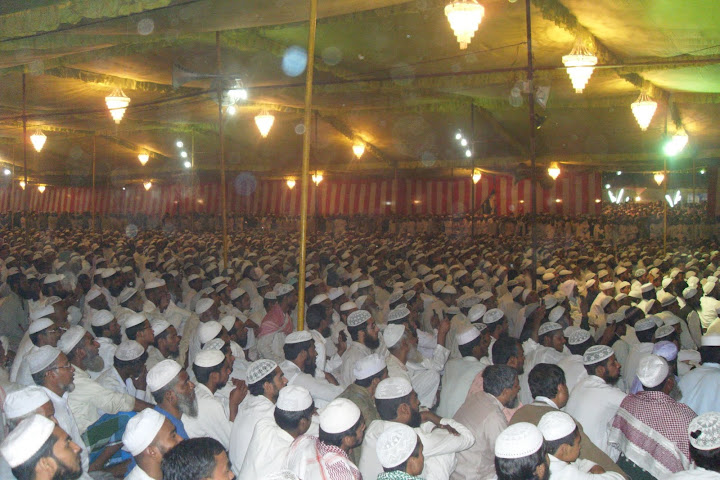
Deoband: The general session of the three-day conference of Jamiat Ulema-e-Hind (JUH) in the historic city of Deoband saw a sea of people on November 3, the last day, coming from almost all parts of the country. Among them were Islamic clerics, political leaders, representatives of religions and social activists. The conference of clerics concluded rejecting the proposed Central Madrasa Board and denouncing terrorism, besides putting various demands before the government.


JUH leaders put across the viewpoints of the oldest Muslim organizations on issues and problems confronting the largest minority community in the country which has third largest Muslim population in the world.


On terrorism, Qari Usman, president of JUH, said: “The entire world is facing the menace of terrorism. Terrorism by any individual or any organization has to be condemned because a country or society can only prosper in peaceful condition. In this connection JUH has organized almost 200 conferences in different parts of the country. We have achieved considerable success on this point and shall continue unless peace prevails in the society.”


On proposed Central Madarsa Board, Qari Usman while delivering presidential speech asserted that the central government’s move was likely to dilute the identity of Madarsas, their aims and objectives and end their spiritual character.


“The setting up Madarsa Board is unnecessary as well as unacceptable. The flaws in the present system could be rectified by setting up a Madarsa Board controlled by the Madarsa functionaries and not by the government” Qari Usman said.


Speaking on the Sachar Committee report, JUH president said that the committee was meant to study the condition of Muslims but later, ignoring the spirit of the report, all minority communities were included in the recommendations. It created huge confusion.


He also warned the government that if their demands were not fulfilled, they would lead a peaceful Mulk-o-Millat Tahrek as they have done in the past.


“The battle being fought under the banner of JUH is not only for the right of the Muslims but it is for the security and unity of the country as well. We want peace and justice prevail in the country” said JUH leader and MP Maulana Mahmood Madni.


He also said that Indian Muslims were proud to be citizens of this country and there is no better place for the Indian Muslims than India to live in. “The beauty of India lies in the fact that people of different language and cultures live here with their unique identities” he added.


On Madarsa Board he said: “We request the government, please do not intervene what we are doing ourselves and demand that government should establish schools, colleges and universities for Muslims and not to insist on setting up a Madarsa Board, if it is really sincere for development of Muslims.”


Maulana Jalaluddin Umri, president, Jamaat-e-Islami Hind said: “Muslims did not ever put for any unlawful demand, yet they have been always ignored which resulted in their lagging behind in every sphere of life. If Muslims would be given chances, they would be at par excellence in all fields.”


Speaking on the occasion Dr. Zafrul Islam Khan, president, All India Muslim Majlis-e-Mushawarat said: “Though some recommendations of Sachar Committee were implemented, Ranganath Misra Commission was not even made public. Government should table the Misra report in the Parliament and take necessary steps to remove the barrier in the way of its implementation."


Congress senior leader and deputy chairman of Rajya Sabha, K. Rahman Khan assured the gathering that government would not establish Central Madarsa Board without taking Ulema into confidence. He also urged the government to take appropriate steps regarding the Waqf properties.


“Ten thousand crore rupees as annual income can be obtained if Waqf properties be used in organized way. The amount is enough to solve most of the problems of the community,” he added.


The 30th Ijlas-e-aam of JUH was more significant than its previous programs in that it was held in Deoband itself where the idea of the JUH was first conceived. The conference sent out a massage that Muslims would not overlook any act of terrorism perpetrated by forces within Islam or outside of it


Union Home Minister, P. Chidambaram appreciated the sacrifice of Muslims in freedom struggle as well as in modern India.


“Who can forget Maulana Qasim Nanautvi, Shaikhul Hind, Maulana Abul Kalam Azad, Maulana Hussain Ahmad Madni and Ashfaqulla Khan etc. who made the efforts and sacrificed for independent India. Muslims have been shoulder to shoulder with other communities for the development of the country,” he said.


“We condemn communalism which is the root of all evils. It was communalism which demolished the Babri Masjid. So, we should fight with that strongly irrespective of religions, castes and creeds.”


Mr. P. Chidambaram, however, kept mum on issues of Central Madarsa Borad and Vande Mataram. On the contrary, he urged Muslims to get modern education along with religious education.


Minister of State in the Ministry of Communications and Technology, Mr. Sachin Pilot said: “Deobandi ulema were the first ones who issued the fatwa against terrorism and they were also in the first row of freedom struggle.”


Renowned Shia Islamic scholar and vice president of Muslim Personal Law Board, Maulana Kalbe Sadiq was of the opinion that Muslim should try to solve their problems by their own efforts and not depend on government’s help.


“We should restore our relation with Allah who can solve our all problems. I do not have trust on any political party because they may cause problems for us and can not solve difficulties” he said adding “I am running medical college, several educational centres and schools but never sought government help. On the contrary, sometimes I have to present huge amount of money to these politicians for lawful works."


Rector of Darul Uloom (waqf), Maulana Salim Qasmi said: “We should oppose the Madarsa Board but we should also find out its alternative. In my opinion Muslim should establish the educational institutions according to government syllabus where students can go for modern education after completion of Madarsa courses.


Yoga guru Baba Ramdev said that Muslims and other communities are lagging behind because of corruption. Politicians looted the wealth of the country and invested it in other countries.


“When I was coming to Deoband, some people asked me if I did not fear going to Kurta and cap wearing people. I replied, not at all because they are my friends and brothers,” he told the sea of Muslims.


Addressing the gathering, Maulana Asghar Imam Mehdi, General Secretary, Markazi Jamiat Ahle Hadees said: “I feel happy to see the leaders of all schools of thought on one stage to consider the Muslim related issues. I wish to come together for every problem of Muslims. Had we been united, we would have not needed such conference for our demand. On the contrary, our demand would have been fulfilled only with saying.”


Maualana Ibrahim who came from UK only to attend the conference urged the community to establish makatibs in every part of the country, so that our children can get education easily.


“Muslims have proved their loyalty with the country time and again. There is no need to sing Vande Mataram as a certificate of being a true Indian” said Sawami Agnivesh.


He also called people to come together to stop wine shops, foeticide and against dowry.


The conference passed 21 resolutions on different issues. They include resolutions on implementation of Sachar Committee and Ranganath Misra Commission reports and Libarhan Commission recommendations, on terrorism, Dalit-Muslim unity, proposed Central Madarsa Board, Palestine, Vande Matram, establishment of religious education centres in rural areas, reservation for Muslims and on Homosexuality.


Other prominent personalities who addressed the gathering were, Kamal Farooqi, chairman of Delhi Minority Commission, Mufti Salman Mansoorpuri, Mufti of Madarsa Shahi Muradabad, Maulana Hayatulla Qasmi, the president of UP JUH, Sitaram Yachury of Communist Party of India (Marxist), Maulana Ahmad Khizer Kashmiri, the rector of Jamia Anwer, Deoband, Pundit N Sharma, Dr. J.K. Jain, Niyaz Ahmad Farooqi, the secretary of JUH, Maulana Siddiqullah Chaudhry, general secretary of WB JUH and many others.


Link:

http://www.jamiatulama.org/

Historic conf. of Jamiat Ulema begins in Deoband; Darul Uloom keeps aloof

TCN in Deoband

By Manzar Bilal, TwoCircles.net,


Deoband: Deoband is a place where programs and symposiums are not new. Because of South Asia’s greatest Islamic seminary Daraul Uloom on its land, Deoband has witnessed several kinds of religious and other programs time to time. But it is first time in the 90-year-history of Jamiat Ulema-e-Hind (JUH) when it is organizing its 30th Ijlase-Aam (general conference) in Deoband. But the seminary is officially keeping itself aloof from the program, making it clear that it does not want to take side of either faction of the oldest Muslim organization in India.


A large number of people especially Ulema and dignitaries from across the country have gathered here at the call of JUH to deliberate and find out the solution of the problems of Muslims in India and all over the world.


The national president of JUH Maulana Qari Usman inaugurated the first session of three-day program in the evening on Ist November by hoisting Jamiat’s flag followed by recitation of its song.


The conference formally began with the recitation of the Quran by Qari Shafeeq sahib, teacher of Darul Uloom Deoband while Maulana Usman Muzafferpuri recited some copulates in the praise of Prophet Mohammad (peace be upon him).


The president of the reception committee, Maulana Haseeb Siddiqi who is also the chairman of Nagarpalika Parishad of Deoband presented the welcome speech. He thanked the delegates from across the country for their cooperation with JUH.


“During last days of his life late president of Jamiat Maulana Asad Madni handed over leadership of JUH to his son Maulana Mahmood Madni and presented him as a future leader of JUH. I remember that after the demise of his father when he took responsibility of JUH he said that he dreamed to see the Muslims to live their lives in the country with dignity and respect and he has been trying much to get his dream true” said Maulana Siddiqi.


The senior leader of JUH and MP Maulana Mahmood Madni said: “JUH has been guiding Muslims and will do the same. It worked for the welfare of the community and country since its foundation and will be doing in the future. We are here to decide what to do in next.”


He also said that JUH is not only a platform of Muslims but also a sign of proud for the country.


“JUH is not a political organization and nor will it be so in future but it will be taking decision for the welfare of the community and making efforts to solve the problems” he added.


Maulana Hakeemuddin, the general secretary of JUH, presented the annual secretly report.


“To serve their wrong purposes and greed some extremist elements tried to link Muslims with unlawful activities, so, Jamiat Ulema-e Hind has been defending on the behalf of Muslim community. For that it has been holding conferences in different part of the country which have left positive impact.” said Maulana Hakeemuddin adding “Last year Jamiat held its 29th ijlase-e-aam on 8&9 November in Hyderabad which was attended by then AP chief minister YS Reddy who announced to remove the problems of constructing of masjids in the state. Afterwards Bangalore, Mumbai and Bhoneshver conferences were organized that created peaceful environment and sent positive message to the world.”


Maulana Qari Usman, president of JUH urged the people to come with Jamiat to defeat communalism and terrorism and to promote secularism.


“After the discussion with Ulema and leaders we will put the problems of the community before government and will appeal to them to solve as soon as possible” he said.


An especial issue of weekly ‘Al-Jamiat’ Ydgar Majallah was also inaugurated on the occasion by the JHU president.


It is to be noted that Jamiat Ulema-e-Hind has special relation with Darul Uloom Deoband because most of its founders and presidents as well as officials from the day of establishment till the date have been products of Darul Uloom. That is why when any program was held by Jamiat in the past, whole Darul Uloom participated in that actively.


But after the death of ex-president of JUH, Maulana Asad Madni dispute was erupted between two products of Deoban – Asad Madni’s brother Maulana Arshad Madni and son Maulana Mahmood Madni – for the presidential post. Since then both have claimed the leadership of the organization and eventually caused faction in it. It was time for Darul Uloom to take strong decision to separate itself from this infighting. Executive committee of Darul Uloom in a landmark decision issued notice to both to accept either post of Jamiat or Darul Uloom. Thus it separated itself from the dispute.


Now today when one group of JUH is holding the conference in Deoband, Darul Uloom once again took a good decision to separate itself from that. Though teachers and any individual were not banned to attend the program there is no changing in daily routine of educational activities in the seminary. Consequently, teachers and students are busy in academic schedule as usual.


This must have hurt the organizers if they had thought that holding of this program in Deoband will send a message across that the seminary is with them.

A look at the Madrasa system of West Bengal

By Manzar Bilal, TwoCircles.net,

History

Madrasa system in West Bengal came with the arrival of Muslims in this part of India, to impart Islamic education. The Madrasah-i-Aliah founded by Warring Hastings (first governor general of East India Company) in October of 1780 in Kolkata, turned a new leaf by introducing modern education as a full fledged subject along with Islamic studies. The madrasah was supported by government funding and was setup with the purpose of providing man-power for the ever growing bureaucracy of Company Raj.

Some other madrasas were established on the same pattern, at the same time scores of traditional madrasa continued to provide Islamic education in their own way.

In 1927 the “Board of Central Madarsah” was established. Madrasas spread over Bihar, Orissa, & Bengal conducted examination under this board. Some independent madrasas were also affiliated to the central board. During partition the board shifted to Dhaka and an interim “West Bengal Board of Madarsa Education” (WBBME) was set up in Hoogly Islamic College. In 1964 the board was revived by inducting 15 members, a president and an advisory board.


Madrasah-i-Aliah [Photo: www.2classnotes.com]


In a landmark decision taken on June 28th, 1994, the government of West Bengal granted autonomous status to the board and passed “West Bengal Board of Madarsa Education Act, 1994”. Since then it has been enjoying status like other school education boards/councils in the state.

As far as finances are concerned, it works the same way as other educational institutions. Independent or private madrasas run on donations and mentorship while govt affiliated madrasa are funded by state government. Earlier West Bengal Board of Madarsah Education worked under the ministry of education, but the present government took a step further and created a separate ministry for it. Mr. Abdus Sattar is the first head of Ministry of Madrasa Education.


Current state of affairs

Out of thousand madrasas in the state, only 508 are affiliated to the board. Muslims comprise 26% of the total population of the state, and these madrasas cater to almost 70% of less fortunate and poorer Muslim population, as they can’t afford higher tuition fees and have to rely on madrasas for primary and secondary education. To meet the educational need of the community, project for opening 70 madrasas by the beginning of the New Year is in the pipeline.

West Bengal Board of Madarsa Education divids education system into three steps; Junior High Madarsa, High Madarsa and Senior Madarsa. At present, there are 168 Junior High Madarsas, 238 High Madarsas and 103 Senior Madarsas.

The subjects that are being taught at Madarsas affiliated or approved by Madarsa Education Board of West Bengal are English, Life Science, Physical Science, History, Chemistry, Geography, Mathematics, Arabic and Islamic Studies.


Junior High Madarsas and High Madarsas are teaching the same syllabus and text books as prescribed by the west Bengal Board of Secondary Education with the additional subject of Arabic and Islamic studies. But Senior madrasas have a little different pattern of education. It’s divided into phases:

Primary stage - classes I-V

Junior stage - classes V-VIII

Alim Stage - Classes IX-X

Fazil Stage - Classes XI-XII

Kamil Stage - Two Years

Mumtazul Muhaddethin (M.M.) Stage - Two Years

English is taught in Madrasahs but not in primary level. Now to modernize the madrasas, State Government is initiating the use of English as medium of instruction.

Achievements

After 9/11 attacks, media widely propagated that madrasahs are tools of fundamental Islamic teachings, they accused madrasahs in all over the world of fostering terrorist activities, but in India not even one madrasa was found guilty of this baseless charge. The irony is, the madrasas of west Bengal have a significant Hindu enrollment, many of these madrasas have Hindu teachers and head masters .In fact in some remote madrasas like Kasba M.M. High Madrasa in Uttar Dinajpur district, Ekmukha Safiabad High Madrasa in Cooch Behar district, Orgram Chatuspalli High Madrasa at Burdwan district and Chandrakona Islamia High Madrasa at West Midnapore district,the number of Hindu students is higher than Muslim students. 618 out of the 1,077 students in Kasba, 554 out of 868 students at Orgram, 201 out of 312 at Chandrakona and 290 out of total 480 students at Ekmukha are Hindus. Madrasas are the only education facility they can avail, also madrasas provide free mid-day meals which is very attractive to poor Hindus and Muslims. In some instances, even well off Hindus send their kids to madrasas, because the madrasahs have exactly same curriculum, same syllabus and same management and same pension and pay for teachers, that of other secondary schools.


Contention and doubts

Though administration of Madrasah Board of West Bengal is hopeful and happy with way things are going, Muslim leaders and many academics do not agree with the concept of the board, according to them Madrasas are meant for religious learning and they should emphasize on that only, they think that madrasa board is sailing in two boats at once.

Advocate Adrees Ali agrees that modernization should be implemented at Madrasas but it should not interfere with religious teachings
“There should be changes in madarsa curriculum with the time but religious education must be prime objective of Madarsa education” he said.

"It is neither fully a madarsas system nor fully a secular system. For Muslims a Madarsas education means Islamic education - an education which has given them the great scholars, academics and imams in the past" said Suleiman Kurshid a history professor.

“Earlier, 80 % religious education was taught at madarsas and 20% modern education but now situation is vice versa and religious education lost its importance in these madarsas as it was called extra subject and no one is interested in religious education there” reports Fakhrul Islam Qasmi, rector of Madarsa Qasimul Uloom, Kolkata.


Besides curriculum, the board and Muslim leaders are at loggerheads on the issue of appointing Hindu headmasters and teachers. Maulana Amanat Hussain, imam of Backer Hostel Masjid, Kolkata says, “Muslims are already unemployed, poor and backward in the state and by appointing non-Muslims at 60 % Madrasas, government has snatched opportunities from them to improve their own financial condition. It was Muslims and not government or any others who donated land to madrasas but now Muslims are being thrown out of madrasas”

The common notion among these Muslim heads is that, it is an attempt to push Muslims economically backwards and to gain stronghold in Muslim institutions. Whereas, the condition of some government madrasas is far from satisfactory.

Madrasah-i-Aliah has been finally given the university status and named as Aliah University in 2008 but it remains to be seen whether it will do anything to improve the educational status of Muslims of West Bengal.

Links:

http://www.aliah.in/
http://wbmadrasahboard.org/

I am not a boot-licker: Dr. Ejaz Ali

By Manzar Bilal, TwoCircles.net,


Dr Ejaz Ali who was elected to Rajay Sabha in March 2008 by Janata Dal (United) from Bihar has been dismissed from the party.

Dr. Ejaz Ali who is also the president of All India United Muslim Morcha is going to hold a program on 1st November in Patna where expelled BJP leader Jaswant Singh is invited. In an interview with Manzar Bilal of TwoCircles.net, he talked on the reasons of differences with the party and purpose behind holding the program.


You have been dismissed from JD (U) along with other two leaders what would be the reason?

Officially I am not informed about this decision so far but I came to know about that through media. The reasons behind dismissal of others two members are clear as they have put their son and wife against party members in election but why I was dismissed I am unable to understand. I am going to organize a program on 1st November at Krishna Memorial Hall, Patna where I invited Mr. Jaswant Singh. It might be the reason for my dismissal because Mr. Jaswant Singh is the leader of BJP who was dropped from the party and JDU is its ally.


Party leaders said that you have been involved in anti-party activities which resulted into your dismissal. What do you say?


Though I was elected by JD (U) but as a representative of a community it was my responsibility to raise voice for the rights of my community. I have been doing my job and whenever I felt anything against benefit of my community I opposed it, be it against my party or any one else because for me interest of community is superior to anything.


Do you feel that policies of JD (U) are against your views?

What are policies of party I do not know but as far as I am concerned I am not boot-licker of anyone but I am deeply concerned about problems of my community. When BJP said that they would construct Ram Mandir at Ayodhya, I opposed it and my party also said that they are not with BJP in this matter. When BJP presented Advani as PM, I stood against it but my party supported it. When Nitish Kumar hugged Narendra Modi, I strongly condemned it. Hemant Karkare investigated on the right direction in Malegon blast case and unveiled the face of saffron terrorism for the first time in India but he was killed. It left suspicion in minds of millions of people. A.R Antulay raised the question in Lok Sabha on the matter and demanded that death of Karkare should be investigated either by the CBI or a serving Judge of Supreme Court. I did the same in Rajay Sabha which angered my party because Karkare was an eye-sore of BJP and RSS. If I had not raised these issues then it is useless to be a member of Parliament.


What is the purpose behind organizing the program on 1st Nov.?


The real propose of program is to inform the people that who are the responsible for partition of India. Since last 62 years Muslims alone have been blamed for partition and because of that they were neglected in every spare of the life. Benefit under Article 341 was snatched from them. Jaswant Singh presented the real history of the partition and cleared that it was power struggle which partitioned the country and there was nothing like Hindu and Muslim factor behind it. So, by this program I want to spread the real history of partition to the people by such a person who is not from my community or group.


But some people say that Jaswant Singh gave clean-chit to Jinnah and Indian Muslim has nothing to do with Jinnah. What do you say?


It is incorrect and a propaganda of BJP that Jaswant Singh gave clean-chit to Jinnah. On the contrary he said that if Jinnah was responsible for the partition, he was not alone but Pandit Nehru, Sardar Patel and policies of Congress were also equally responsible for that. He also accepted that Muslims have been discriminated in their own country without any sin.

It is reality that partition was the product of politicians which pushed the country to backwardness because it was unnatural but common people are unaware about this fact. We are going to make an organization in which people from all communities will be given representation from where we will work for the communal harmony by visiting all parts of the country. The program of 1st Nov. is first part of that movement.


People say that you are going to hold program only to strengthen your political image among people so, that you can get benefit in the election? How much is it true?


My 25-year service in medical field and work for downtrodden and the depressed sections are enough to get people’s support and I have used it in the elections for my community’ benefit. It is a fact that I got elected MP by JD (U) because of my familiarity among people. So, I do not need to organize such program for my publicity.

You are claiming that you have raised voice for the right of Dalit Muslims but after reaching Parliament you have forgot the issue. What is your answer?

I am the first man who stood for Dalit Muslim issue. I was badly injured during a demonstration before Bihar assembly house with the demand to pass resolution for inclusion of Dalit Muslims under Article 341 and Bihar assembly passed the resolution.

I also held an agitation before Parliament house in Delhi for the same purpose and beaten up by police. I am happy that this issue has reached to Parliament. Now when I stand in Rajya Sabha, people consider that there might be any Dalit Muslim related issue. Those who are blaming me have nothing to do with Muslim issues and they are doing that only to appease their political bosses.


What is your plan in next Bihar assembly election, will you take part in that?

No, I will not take part and also will not make any party but I will campaign among the people to change the government at every 5 years. So that politicians would work more for the development of the state because even after 62 years of independence, Bihar is lagging behind only because of dynasty system of government.

Any thing else to say?

I can not compromise with benefit of my community and country at any cost and I appeal other member of Parliament to do the same. I also request people to support the truth and beware of tricks of politicians because they always try to create infighting among people.


(About the interviewee: Dr. Ejaz Ali is M.B.B.S., M.S. (General Surgery) practicing in Patna and son-in law of late Bihar assembly speaker Ghulam Sarwar. He is national president, All-India United Muslim Morcha, chief editor and Publisher, Sangam, an Urdu daily, published from Patna.)

Muslims, though most neglected, little interested in using RTI: Perveen Amanullah

By Manzar Bilal, TwoCircles.net,

It was a good step by UPA government in 2005 when it introduced Right to Information (RTI) Act as it gave a ray of hope to millions of citizens seeking transparency and accountability in government. Four years down the line, have citizens got real fruits of the Act? Yes, but not fully, says Mrs Perveen Amanullah, president, Bihar Suchna Adhikar Munch, in an interview with Manzar Bilal of TwoCircles.net on the 4th anniversary of RTI.

RTI Act completed its four years. How do you think people benefited from this act during these years?


Of course, lots of people have got benefits by RTI in the country. Though I have been actively involved in social work since 2002 in Delhi, but two years ago when I came Patna, I started to work for public welfare by using RTI Act. We can show you the record of thousands of people whose cases we solved and they got their rights by the virtue of this act.


Mrs Perveen Amanullah, president, Bihar Suchna Adhikar Munch


The most famous work of us in Patna which hit the news headlines and angered the government officials was the case of Patna Medical College and Hospital (PMCH). There was corruption everywhere in the hospital. Patients had to pay for every little and big work. But when we used RTI against these corrupt doctors, nurses and workers, though after a big battle, they had to give up their activities and now situation at PMCH is normal.

There are many cases in which applicants were turned away, harassed, sometimes put behind bar and charged with criminal cases. What do you say about it?

Yes, I know that only to avoid exposure of their involvement in corruption, officials of several departments tear down applications and threat applicants. Currently, we have received 40 complaints from several parts of the state which say that people were booked with false criminal cases such as murder, attempt to murder and rape only because they used RTI. This is very dangerous trend in a democratic India. But even though we should not give in to these corrupt officers, on the contrary we should use this in more numbers and continue our efforts.

What should be done to curb this problem?

We and some other social organizations working in this field are demanding the government to take some necessary steps for effective implementation of RTI. Guilty officers should be punished, so that rights of citizens can be saved.

How much Muslims are interested in using RTI?

I am sorry to say that Muslims are not interested in using RTI. We Muslims are facing many problems in the country and we are the most backward community. Of course political parties and government officials have been neglecting us, but we should also examine that what we ourselves have done for us. This is a democratic country; we should fight for the cause of our rights being in the limitation of Indian constitution. We can solve most of the problems by using RTI. Instead of abusing others we should act for our rights.

But it seems that we are happy with our problems. Therefore, we are behind all other communities in taking benefit of RTI as we are in other fields.

What do you plan for spreading awareness about RTI?

Media can play an important role for creating awareness among all deprived people about RTI. So they should do their work as much as they can. As far as we are concerned we are holding awareness program time to time and we are always ready to attend the related programs. We are going to hold programs at district level to make awareness about RTI and also to hand over memorandums to district magistrates about people’s problems.

What is your massage for the people?

I humbly request all depressed people that constitution has given them a means in the form of RTI by which they can solve their problems. They should not be prey of any street leaders who might grab a big amount of money in the name of their works. On the contrary they should use RTI without any hesitation for any kind of problem.

(About the interviewee: Mrs Perveen Amanullah is wife of Bihar’s principal secretary for home, Mr. Afzal Amanullah. An eminent social activist in the state, Mrs Amanullah has been working for rights of people for years using RTI Act.)

Contact:

Humlog Trust Office,
Alankar Jwellers building, 1st floor,
Muradpur, Patna, Bihar.
Office: +919304732990
Email: parveen.amanullah@gmail.com

Muslim League reviving its cadres in Bihar to contest next assembly poll

By Manzar Bilal and Mudassir Rizwan, TwoCircles.net,

Patna: “If Muslims had been united, no political party or government would have ignored them. It is a matter of concern that Bihar has 18% Muslims but it has not given reservation to them while other states like Kerala, Andhra Pradesh, Tamil Nadu, and Karnatka have sanctioned reservation for them” said Mr. E. Ahmad, the Railway Minister for state, here on 11 October.


He was addressing a program organized by Bihar chapter of Indian Union Muslim League at conference hall of Taramandal in Patna.

Mr. E. Ahmad who is also national president of Indian Union Muslim League came here at his two-day visit to gear up the workers and members of the party for assembly election in the state likely to be held next year.


Criticizing Bihar political leaders, he said that Muslim community of the state has got nothing from those politicians who came to power in the state and enjoyed long terms by the virtue of Muslim votes.

“Leave alone to do any thing for the betterment of the Muslims, the state government did not implement lots of central government’s schemes meant for minorities. I really regret upon the situation in the state” he added.


He highly praised the Prime Minister Dr. Manmohan Singh for his welfare schemes to uplift the minority communities.

“It was Dr. Manmohan Singh who concerned the problems of Muslims and started some welfare schemes to solve them and at least he gave Muslims assurance to meet their challenges. But I cannot say that all problems of the community have been solved during the regime of Manmohan Singh” said Mr. Ahmad.


“We are national Minority and we are not asking charity from any one but our constitutional rights along with other backward classes” he added.

He also said that Muslim League has been representing in the parliament since 1952 till the date without any break though sometimes with one or sometimes with two members. On the contrary there were many parties that came and went and now that do not have even regional appearance.


“Muslim League will contest the next assembly election in the state with enthusiasm and it will also give the fair representation to women. Therefore, I appeal to women to come forward and take part in the activity of Indian Muslim League” he said.

Urging the party workers, he said: “We should strengthen the party at village level, for that we will have to work hard and go from door to door.”


Hundreds of common people, dignitaries and party workers including women were present in the program to listen to Mr. E Ahmad.

Speaking on the occasion, the president of Bihar Indian Muslim League, Mr. Naeem Akhter said that the party has succeeded to have its units in 20 districts out of 38 in the state and trying to get recognition across the state.

“We have examined all parties in the state but they did not do anything for us. So, it is time to give a chance to Indian Muslim League. Insha Allah (if God wills) you will get the fruits on the pattern of Kerala” he promised.

687 reads

Urdu is an integral part of the nation: Nitish Kumar

By Manzar Bilal, TwoCircles.net,

“Urdu is one of the sweet languages of our country. It has played a vital role in freedom struggle. It has always been promoting communal harmony. Urdu writers and editors were put behind the bar by British government because they were writing on the importance of freedom and against British government in their newspapers and magazines.” said Bihar chief Minister Mr. Nitish Kumar.

He was speaking at a program held on the topic 'Urdu Language and National Unity' in Patna on Thursday.


He also said that Urdu is an integral part of the nation and one can not deny its importance in our peaceful society. So, it must be taught in each school on a voluntary basis.

What Mr. Nitish Kumar said is an undeniable fact that to teach Urdu in each school is an easy way to promote it. But it is also a truth that Urdu language is passing through a critical period and facing lots of trouble across the country including Bihar where it is second official language.

If honorable chief Minister knew the importance of Urdu, why he did not initiate for full implementation of it in government offices during his regime and why Urdu teachers were not appointed though many seats are vacant?

Reality is that after Mr. Jagannath Mishra no one came at the post of chief minister in the state who has shown his sincere efforts for the betterment of Urdu language. Therefore, with each day passes the situation is getting worst.

However, Mr. Ahmad Saeed Malihabadi, the editor of daily Azad Hind, Kolkata, urged Mr. Chief Minister that he should appoint Urdu teachers in every school so that people can learn it easily.

“Bihar was the first state which made Urdu second official language which was followed by some other states so; the state should come forward to make available Urdu teachers at every school” he said.

Reacting to this proposal Chief Minister Nitish Kumar asked on the occasion the Rajbhasha department secretary Girish Shankar and chairperson of Urdu Mushawarti Committee and famous poet Dr. Kaleem Ajiz to prepare and present a proposal to appoint Urdu teachers at every school. He also said that the schools should have a separate Urdu department and those who wish to learn the language should be able to take the course without having to transfer to other schools.

Program was organized by State Rajbhasha Department and Urdu Mushawarti Committee at conference hall of Taramandal, in Patna. The hall was thronged to its capacity with audiences.

It will be interesting to see that weather these promises made by chief minister would be seen on the ground ever or will remain only on the paper.

Other prominent political and social personalities who addressed the gathering were Dr. Kalim Aziz, Chandrabhan Khayal of National Council for the Promotion of Urdu Language, State Minority Commission chairperson Naushad Ahmed, Khuda Baksh Library Director Dr. Imtiaz Ahmed, and Patna University Pro-Vice Chancellor Dr. S. Ehsan.

1561 reads